
2026: Meet Your Mutuals
The point of social media is to meet people! (not followers!)

Contemporary social media can feel a bit haunted. Not by literal ghosts but following lists can be haunted by a seemingly indelible past of one-time encounters.
I recently published an essay on connection bloat and Instagram friends. The learning is clear every year our following lists increase but our feelings of connection do not. For the research, I surveyed 500+ Instagram users and did 20 interviews, if you want to talk about it, send me an email! To celebrate the launch, I also hosted an event with the Mozilla Foundation where we unfollowed people en masse. Got to practice what I preach.
Specifically, contemporary social media teems with a novel site-specific type of acquaintance: the timeline acquaintance. The timeline acquaintance is not a friend, nor someone with whom you have an acknowledged and sustained relationship, nor an acquaintance which would imply a certain frequency in your encounters. They are a tertiary figure in your social graph.
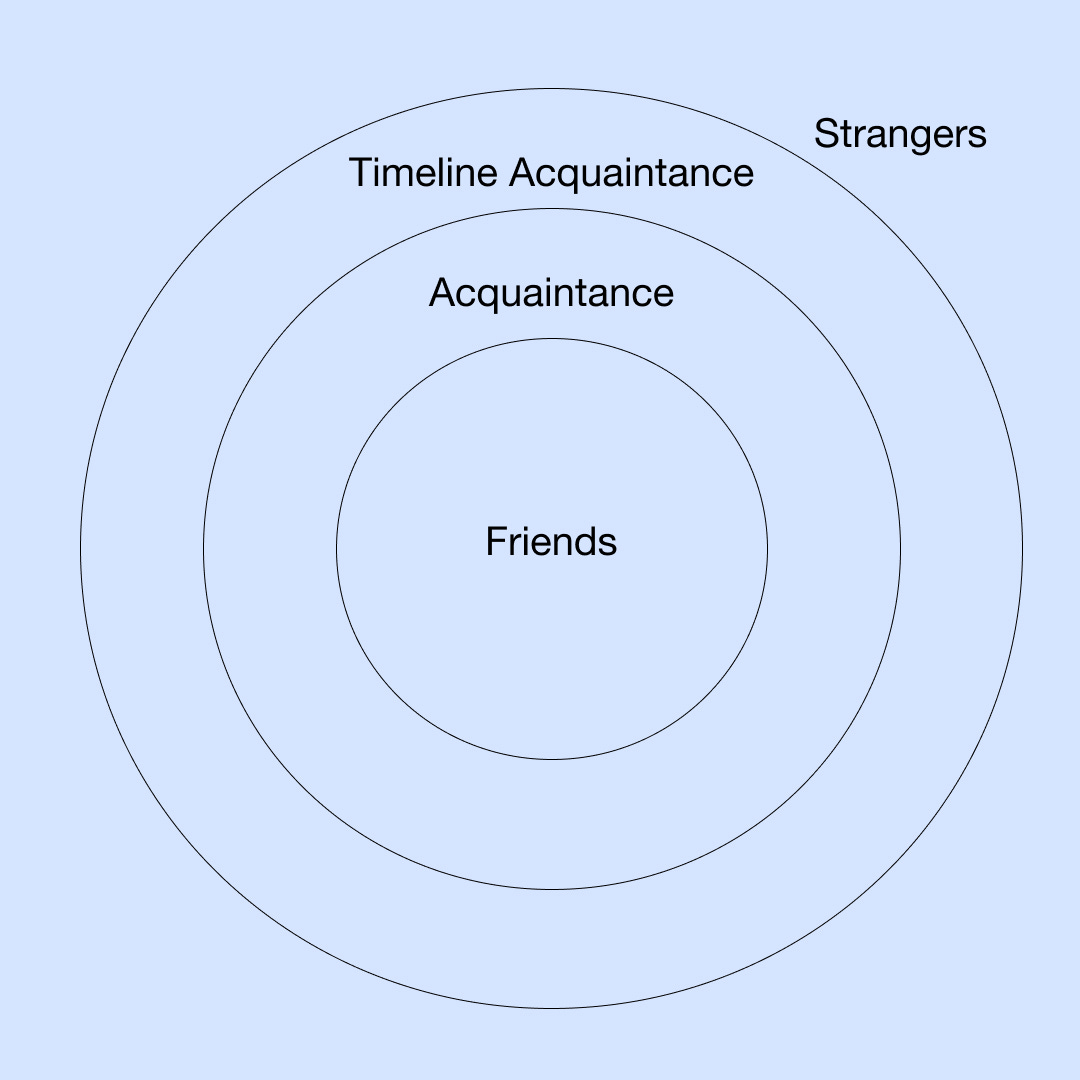
You’ve met them once or twice at a function, opening, talk, etc. and, over a well-deserved cigarette, you decided to exchange instagrams (because email is too corporate and number a bit too flirty.) And now you’re privy to your timeline-acquaintance’s weekly goings-on, their yearly family trips, their dietary habits, their workout routine, and, on a holiday, you might even encounter a picture of their partner or their parents.
In a pre-social media world, you would never be privy to such information. These individuals exist staunchly outside of your Dunbar circle of interaction. In the 1990s, anthropologist Robin Dunbar hypothesized what would become known as the Dunbar Number or approximately 150, which was, based on his research, the cognitive upper limit of stable social relationships a human being can maintain.
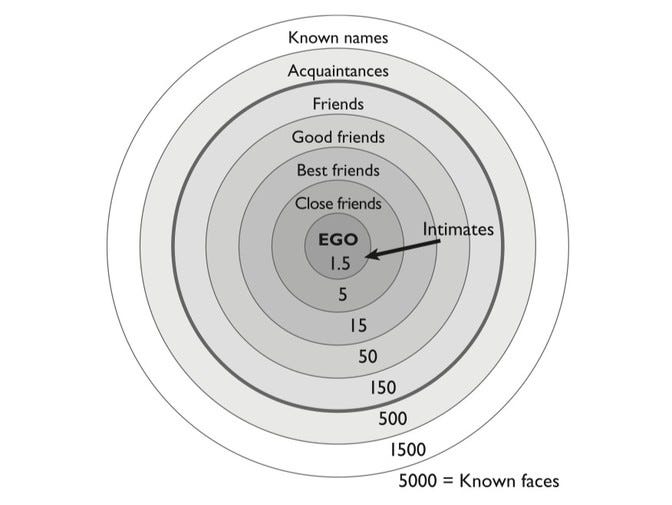
This number emerged from primate studies linking neocortex size to average group size, and Dunbar extrapolated this limit for humans based on our brain’s processing capacity, emotional bandwidth, and the time constraints required to sustain meaningful interaction. The Dunbar Number was conceived in a pre-digital context when keeping up required friction: shared geography, conversational upkeep, mutual investment. (Not just a mass text or the ambient co-presence of the close friends story)
There was a definite intentionality in the act of keeping. Following is not the same as inquiring. Information is received through algorithmic whims. Previously, such information would have been obtained if you met the person a third time and, after struggling to recall their name, you might be made aware of the fact that they’re engaged, moving to Berlin or opening a boutique grocery store in Porto.
The timeline acquaintance represents a new form of social bond, a new form of weak tie. In traditional sociology, we speak of weak ties when describing relationships characterized by low emotional intimacy and infrequent interaction. The concept comes from Mark Granovetter and his landmark 1973 paper, The Strength of Weak Ties.
It’s called The Strength of Weak Ties because weak ties are very important. Counter-intuitively, weak ties tend to be where most opportunities are found, because they exist outside of the closer circle in which the shared information tends to be homogenous. Whether it be a grant, a job or a business partner, weak ties inject novelty because you may not share so many common social ties and connections.
Granovetter in his 1973 study found that 83.4% of workers who obtained jobs through personal contacts did so through weak ties rather than close friends or family, suggesting that the periphery of our social networks may be disproportionately valuable. Given the insight on weak ties, I believe this probably extends to timeline acquaintances. You should meet them!
My dear friend Rue has always been very good at this. I believe this is how we met. I emailed them after seeing one of their videos. And now we’ve gone on road trips, watched movies together, went to a wedding, spent a weekend in the Hamptons and even written an essay together, and, I’m sure, we’ll do more! I feel blessed and lucky to have Rue in my life, but it wouldn’t have happened without reaching out.
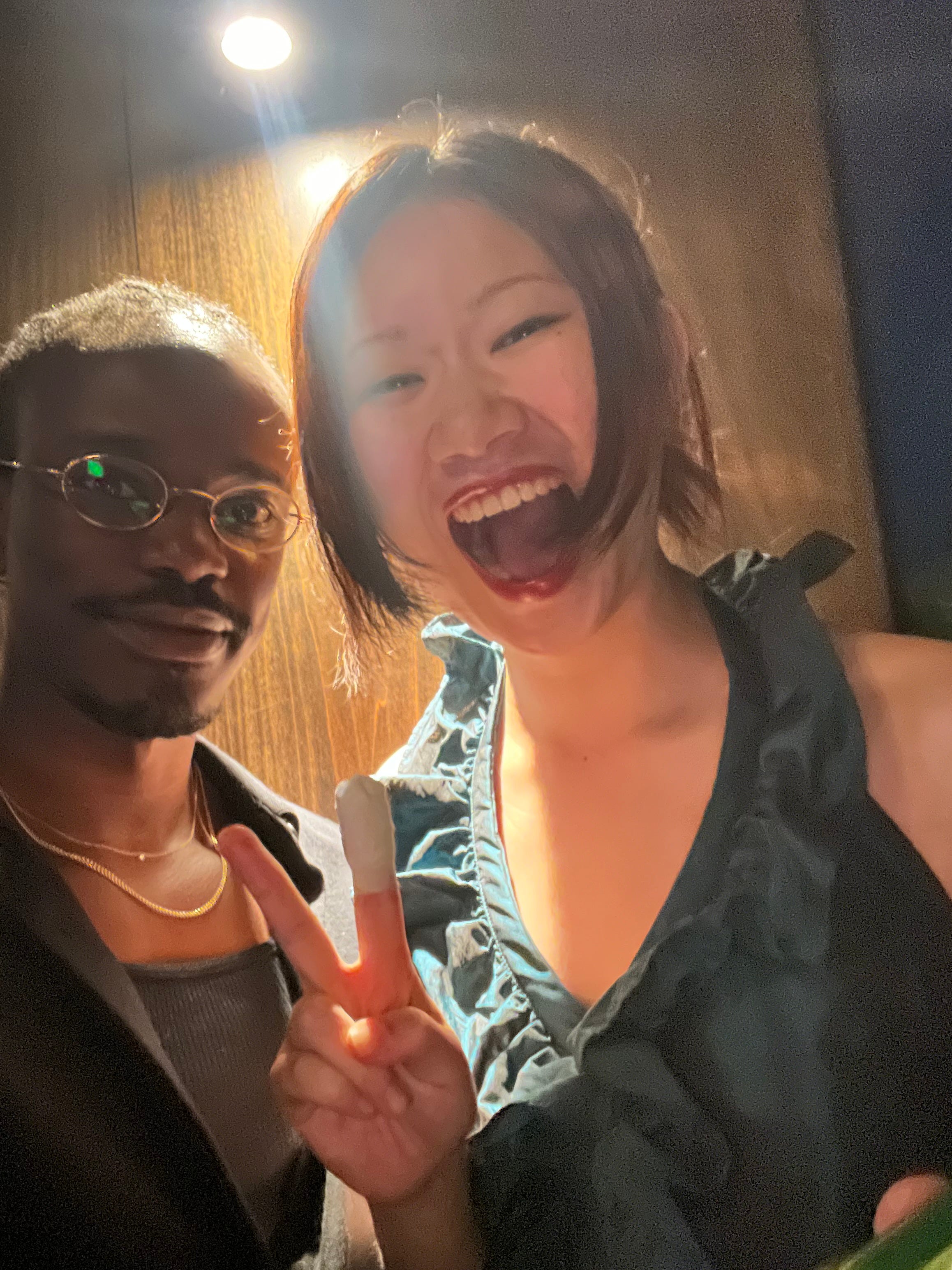
The point of social media is not followers, it’s people. The reason we are networked is so it is easier for us to communicate and ultimately hang out. To riff on my friend Josh’s famous saying, ‘Reach into the internet, pull the people out.’
It’s that simple really.